Nahom, and three altars found in Yemen
ContestedLDS scholars have a real answer here. Say so before your friend does.
The evidence
The verse
1 Nephi 16:34 says Ishmael was buried "in the place which was called Nahom." Note the wording. The party did not name it; they found it named.
Then, at 1 Nephi 17:1, they turn "nearly eastward."
What was dug up
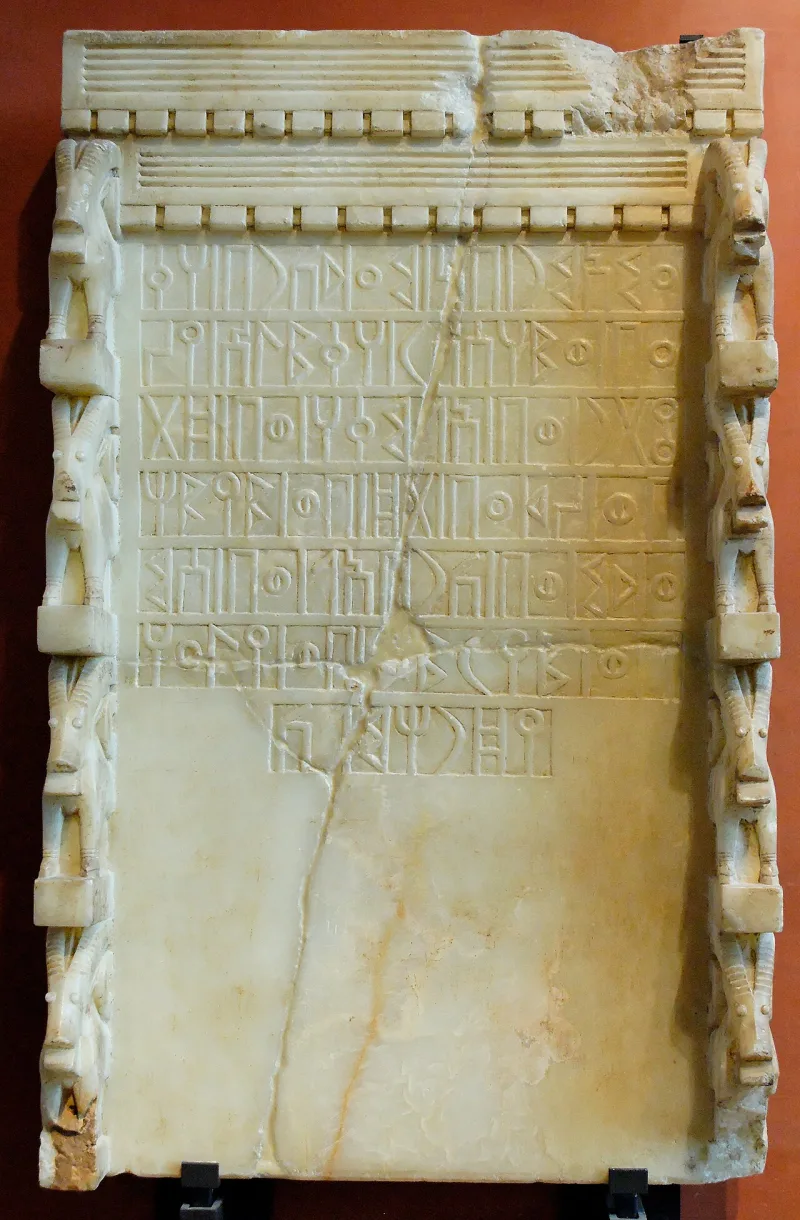
Three limestone altars from the Bar'an temple near Marib, in Yemen, found from 1988 onward. Each carries a dedication by a donor of the NHM tribe, the Nihm.
They date to roughly the 600s or 500s BC — Lehi's era. And the Nihm region sits near where the frankincense trail bends east toward the coast.
Their answer, at full strength
Warren Aston and Scripture Central call this a precise external hit. NHM is rare as an Arabian place name.
The altars anchor the tribal name to exactly Lehi's period and region. Nobody in 1820s New York could have known that.
And they stress the chain. A burial place carrying a root that means mourning.
Sitting exactly where the text turns east. Ending at plausible candidates for Bountiful on the Omani coast.
Each link, they say, multiplies against coincidence.
The critical reply
The inscriptions give three consonants naming a tribe, not a place called Nahom. The NHM root is common in Semitic names.
The eastward turn follows the trade route everyone used. And a form of the name, Nehhm, appears on European maps from Carsten Niebuhr's expedition, in English by 1792.
Archaeologists outside the church see nothing in it; Philip Jenkins wrote that "there's no there there."
How strong is this argument?
Genuinely arguable, and be honest: this is their best single piece of evidence. A real inscription, correctly dated, plausibly placed.
Give it its full weight before you answer. Then note the scale.
One consonant cluster in Arabia does not offset an empty New World, where a thousand years of the story take place.
What to say
"Nahom is a real hit and I'll say so. What have we found in the Americas?"
How they answer this — at its strongest
The altars date the NHM tribe to Lehi's era, right where the text turns east.
Warren Aston and Scripture Central argue that NHM is rare as an Arabian place name. The altars independently tie the tribal name to precisely Lehi's period and region. That was unknowable from 1820s New York.
They note that no evidence connects Joseph Smith to Carsten Niebuhr's maps.
And they stress the chain of hits. A burial place bearing a Semitic root that carries the sense of mourning and consolation. Positioned exactly where the text turns the party east. Ending at plausible candidates for Bountiful on the Omani coast.
That chain, they argue, multiplies well beyond coincidence.
The verdict
Their best single piece of evidence. Give it full weight, then ask about America.
Honesty requires ranking this as their best single datum. It is a real inscriptional match, correctly dated and plausibly located.
It is also weaker than it is usually presented. A tribal name of three consonants. A root common in Semitic naming. A turn that follows the trade route everyone took. And a form of the name, Nehhm, on published European maps in English by 1792, decades before 1829. Archaeology outside Mormonism sees nothing evidentiary in it. Philip Jenkins wrote that 'there's no there there'.
Both sides field serious arguments from real data, which is the definition of contested.
Grant Nahom its full weight. Then note that one consonant cluster in Arabia cannot offset the total absence of Nephite evidence in the New World, where the story's thousand years unfold.
Sources
- Scripture Central: Book of Mormon Evidence — Nahom
- Philip Jenkins: The Nahom Follies
- MRM: Finding Nahom — The Continuing Search for Archaeological Confirmation
- Ryan Thomas: Nahom and Lehi's Journey through Arabia, Part 3
- FAIR: Possible locations for Nahom