Facsimile 3: a goddess labelled 'King Pharaoh'
UnrefutedNo good counter-argument has been published by LDS scholars.
The evidence
Why this one is the cleanest test
The captions survive. Facsimile 1 has a hole in it.
Here the hieroglyphs beside each figure are printed in the woodcut, and Egyptologists can read them.
What the scene is
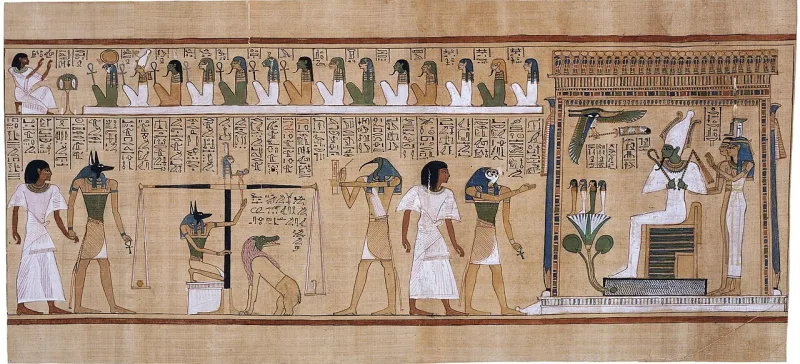
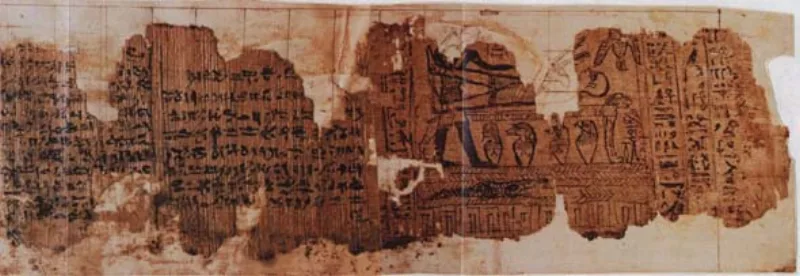
A standard presentation vignette from the Book of Breathings of the priest Hor. The dead man Hor is led by Maat and Anubis, and presented to Osiris on his throne, with Isis behind him.
What the captions say
Robert Ritner translated them. Figure 2, which Smith called "King Pharaoh, whose name is given in the characters above his head," is captioned "Isis the great, the god's mother." A goddess.
Figure 4, which Smith called "Prince of Pharaoh, King of Egypt," is "Maat, mistress of the gods." Also a goddess. Figure 1, Smith's Abraham on the throne, is Osiris.
Figure 5, Smith's "Shulem, one of the king's principal waiters," is "The Osiris Hor, justified forever" — the owner of the papyrus. Figure 6, Smith's slave Olimlah, is Anubis.
Who has checked this
Théodule Devéria reached the same conclusions in 1860. So did the 1912 panel of Egyptologists, which included Flinders Petrie and James Breasted.
They worked independently.
Their answer, at full strength
It does not offer a rival translation. Gee, Muhlestein and Pearl of Great Price Central accept the readings and argue for relabelling.
In Egyptian thought Pharaoh embodied Osiris on earth, and Isis could be identified with the throne itself, so Isis as Pharaoh has some precedent. Jews in Egypt did adapt Egyptian scenes for their own figures, and Abraham turns up in later Egyptian magical texts.
Presentation scenes do dress figures in one another's imagery. And some caption glyphs are poorly copied in the woodcut.
What to say
"He said the name is written above the head. It's written.
It says Isis."
How they answer this — at its strongest
They accept the readings, and say Jews reused the scene for their own story.
The strongest case comes from Gee, Muhlestein and Pearl of Great Price Central. It offers no rival reading of the captions. It accepts them, and argues that the figures were relabelled.
First, in Egyptian thought Pharaoh stood for Osiris on earth. Isis could be tied to the throne itself, and even to the king. So Isis as Pharaoh has some precedent.
Second, Jews in Egypt plainly took Egyptian scenes and used them for their own figures. Abraham turns up in later Egyptian magic texts. So an old Jewish editor could have relabelled this as Abraham at court.
Third, scenes of this kind do dress one figure in another's imagery. So crossing gender in a label is not unknown.
Fourth, some of the glyphs are copied badly in the woodcut. The Isis name group is one. That clouds what stood on the original.
The verdict
Strong for you: he said the name is written above the head, and it says Isis.
This is the hardest facsimile case for their side. Smith staked his labels on the characters themselves: 'whose name is given in the characters above his head'. Those characters can now be read. They say Isis and Maat. Not a Pharaoh. Not a prince. Where Smith saw 'Shulem the waiter', they name Hor, who owned the papyrus.
No source on their side offers a rival reading. Théodule Devéria reached the same result in 1860. So did the 1912 panel that included Flinders Petrie and James Breasted.
Their answer accepts the Egyptology and posits an old relabelling that no document shows. Not on this papyrus.
The church's own essay grants that Egyptologists read it differently from Smith. It stops short of granting error. So the verdict is unrefuted rather than admitted.
This was a checkable claim made in the name of the gift and power of God. On the evidence as it stands, it fails the test of 1 Thessalonians 5:21 and Deuteronomy 18.
Sources
- Ritner, The Joseph Smith Egyptian Papyri: A Complete Edition (2013) — Facsimile 3 caption translations; quoted in FAIR's treatment
- FAIR: responses to Joseph Smith's interpretations of Facsimile 3 (quotes Ritner, Parker, Baer readings)
- Pearl of Great Price Central: 'Isis the Pharaoh (Facsimile 3, Figure 2)'
- Gospel Topics essay: 'Translation and Historicity of the Book of Abraham' (LDS Church)
- Book of Abraham Facsimile 3 analysis with caption images (4witness)