Facsimile 1: Abraham, or a funeral scene
ContestedLDS scholars have a real answer here. Say so before your friend does.
The evidence
What Joseph Smith said it shows
Abraham "fastened upon an altar." Over him, "the idolatrous priest of Elkenah attempting to offer up Abraham as a sacrifice." That is his own printed explanation, figures 2 and 3. Abraham 1:12-15 tells the story.
What Egyptologists say it shows
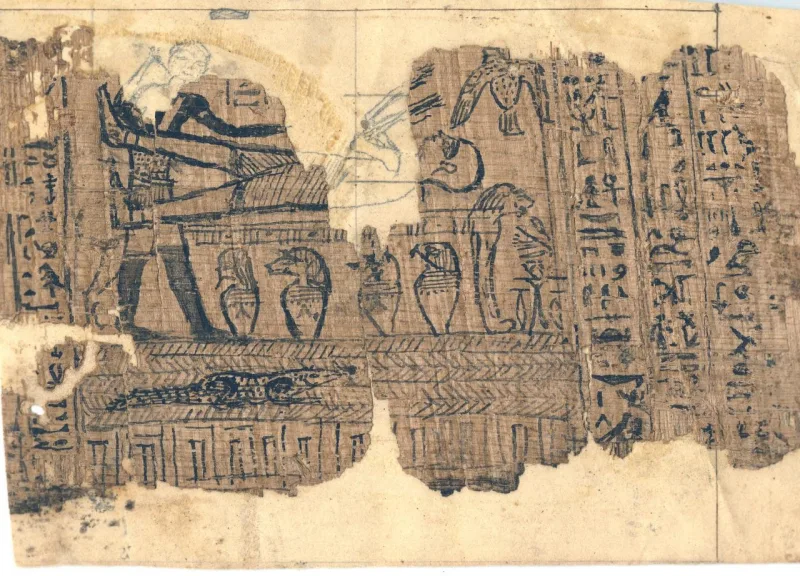
A standard funeral scene. The original survives as Papyrus Joseph Smith I. It is part of the Book of Breathings made for a Theban priest named Hor, around the second or first century BC. That is more than 1,500 years after Abraham.
The scene shows the jackal-headed god Anubis tending the dead man on a lion couch.
The gap in the page
The papyrus has a hole. It sits exactly where the priest's head and the knife appear in the 1842 woodcut.
The woodcut shows a bald human head and a raised knife. Robert Ritner and others note ink traces of a headdress at the shoulder, which points to Anubis.
And no other scene of this kind has a knife in it.
Their answer, at full strength
John Gee, Kerry Muhlestein and Pearl of Great Price Central make four points. Nobody knows what filled the hole, so a human head and a knife could have been there.
This scene is unusual: the figure on the couch looks alive and clothed, with both hands perhaps raised. Egyptian temple texts do show ritual killing of enemies, so a sacrifice reading is not absurd.
Jews living in Egypt did reuse Egyptian pictures for their own stories. And the catalyst view says the papyri only prompted revelation, so the explanations are inspired comment rather than translation.
How strong is this argument?
Genuinely arguable, unlike the other two facsimiles. The hole covers the very things in dispute, so the case runs on parallels and ink traces.
The Egyptological reading is far better supported, and the church's own essay grants that Egyptologists read it differently. But note the rest.
The canopic jars as gods of foreign nations, and the crocodile as the god of Pharaoh, have no support at all.
What to say
"What do you make of the missing piece? That's where the whole argument sits."
How they answer this — at its strongest
The hole covers the very figures in dispute, so nobody knows what stood there.
John Gee, Kerry Muhlestein and Pearl of Great Price Central argue four things.
First, the hole means nobody knows what the original showed. Some hold that the papyrus was already torn in 1835. A knife and a human head could have stood there. They add that this scene is odd for its type. The figure on the couch looks alive and clothed, with both hands perhaps raised.
Second, Egyptian temple texts do show enemies ritually killed. So a sacrifice reading is not absurd.
Third, Jews living in Egypt plainly reused Egyptian pictures and gave them new meanings. So this scene could have gone with an Abraham text, whatever it was first drawn for.
Fourth, on the catalyst view the papyri were only a prompt. That makes the explanations inspired comment, not Egyptology.
The verdict
Arguable, unlike the other two. The hole sits right where the argument is.
Unlike Facsimiles 2 and 3, this one has a real gap in the evidence. The hole covers exactly the disputed parts. So the restoration case runs on parallels and ink traces, not on a surviving original.
The scholarly reading is far better supported. Anubis, in a routine embalming scene from Hor's Breathing Permit. Ink traces of a headdress at the shoulder. Hundreds of parallel scenes. And no parallel at all with a knife in it. The church's own essay grants that Egyptologists read it differently.
But they dispute what filled the hole, not the Egyptology. And the scene does have odd features. So this figure is scored contested.
Note the labels around it, though. The jars as gods of foreign nations, and the crocodile as Pharaoh's god, have no support at all.
Sources
- Robert K. Ritner, The Joseph Smith Egyptian Papyri: A Complete Edition (2013); 'The Breathing Permit of Hor' (JNES 62, 2003) — summarized with translations
- Gospel Topics essay: 'Translation and Historicity of the Book of Abraham' (LDS Church)
- FAIR: Book of Abraham facsimiles — missing portions of Facsimile 1
- Pearl of Great Price Central: 'The Idolatrous Priest (Facsimile 1, Figure 3)'
- Book of Abraham Facsimile 1 analysis (4witness)