Why 'spread by the sword' is wrong: Indonesia
Don't useThe Muslim answer holds up. Do not lead with this one.
The evidence
The claim
A common line says Islam grew by force alone. People were made to convert wherever the armies won.
It is then set against the early church, which grew while under attack.
What actually happened
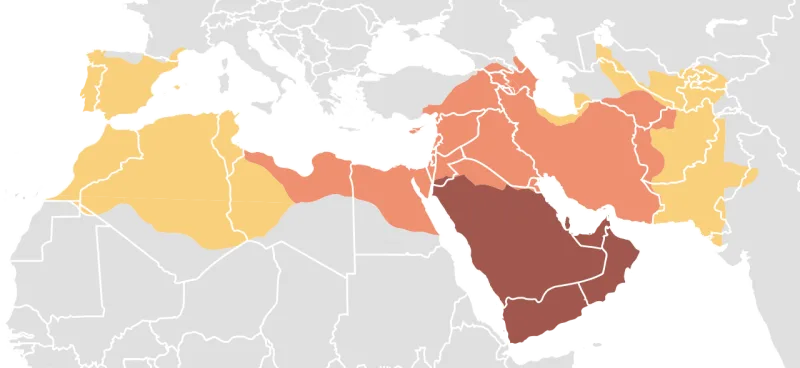
The armies did conquer quickly. Conversion was slow and mostly voluntary.
Richard Bulliet's conversion curves show Egypt, Syria and Persia stayed majority non-Muslim for two to three centuries under Muslim rule. Ira Lapidus documents the same pattern.
The tax proves it
The jizya and dhimmi system assumed large non-Muslim populations. You cannot tax converts you have forced to convert.
So the system's own logic worked against forced conversion.
Where Islam grew without armies
Indonesia is the largest Muslim country on earth. No Arab army ever conquered it.
Islam arrived through traders and Sufi networks. Much of West Africa is the same story.
Forced conversions did happen, but they were exceptional, and jurists often condemned them citing Quran 2:256.
Do not use this one
The caricature fails, so drop it. What survives is narrower and documented, and it is on this site elsewhere.
Islamic law does contain coercive provisions — apostasy, and jizya paid "while they are humbled" — with no New Testament parallel. Argue that documented asymmetry, not the slogan.
What to say
"Islam did not spread only by the sword, and I will not say it did. Can I ask about something narrower?"


How they answer this — at its strongest
The armies won fast, but people came to Islam slowly, and mostly by choice.
The record answers the caricature. The armies did conquer fast. But conversion was slow, and mostly by choice. Richard Bulliet studied conversion curves. He found that Egypt, Syria and Persia stayed mostly non-Muslim for two to three centuries under Muslim rule. Ira Lapidus records the same pattern.
The reason lies in the tax. The jizya and dhimmi system assumed large non-Muslim populations, and you cannot tax converts you have forced. Indonesia is the largest Muslim country on earth, and no Arab army ever took it. Islam arrived there through traders and Sufi networks, as it did in much of West Africa. Forced conversions did happen, but they were rare, and jurists often condemned them citing 2:256, no compulsion in religion.
The verdict
Do not use this one: argue the coercive laws instead, which are documented.
Weighed fairly, the only by the sword claim fails. Conquest and conversion were two different things, and the tax system proves it.
What survives is the narrower point made elsewhere on this site. Islamic law does contain harsh rules. There is death for apostasy, and jizya paid while they are humbled. The New Testament has nothing like them. And the order Islam built made conversion easy in one direction only. Argue that gap, which is documented, not the caricature. It is marked answered so the credible form of the argument stays credible.
Sources
- Ira Lapidus, A History of Islamic Societies (Cambridge UP) — conversion followed conquest by centuries
- Richard Bulliet, Conversion to Islam in the Medieval Period (Harvard UP)
- Spread of Islam (survey: trade and Sufi networks in Indonesia, West Africa)