The Quran's inheritance shares add up to 27/24
AdmittedThe facts sit in Islam's own trusted sources. You can make this point from their books alone.
The evidence
The rule
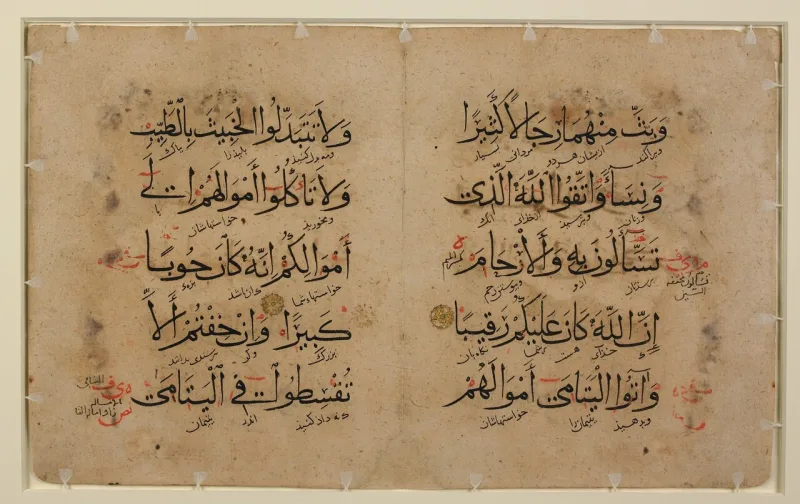
Quran 4:11-12 and 4:176 assign fixed shares of an estate. The verses read as direct commands about real portions.
Quran 4:11 closes by calling it an obligation from Allah.
The arithmetic
Sometimes the shares add up to more than the estate. A man leaves a wife, two daughters and both parents.
That is 1/8 plus 2/3 plus 1/3, which is 27/24. Another leaves a mother, a wife and two sisters.
That is 1/3 plus 1/4 plus 2/3, which is 15/12.
The fix Islam devised
Islamic law admits the problem. The doctrine of awl reduces all shares proportionally.
By IslamQA's own account, no such case arose under Muhammad or Abu Bakr. Umar was the first caliph to rule on it.
So the law described as perfectly detailed (Quran 6:114) needed a human patch within a decade.
The Muslim answer, at full strength
IslamOnline answers that the verses assign shares, not a total. When shares oversubscribe, awl keeps each heir's proportion relative to the others, which they say is the design.
It is a ratio system, not an addition problem. IslamQA adds that the companions' agreement on awl shows flexibility, not a defect, and that the Quran never promises the fractions sum to one in every case.
How strong is this argument?
They admit the substance themselves. The shares do exceed the estate, and awl was a later human ruling — IslamQA says so plainly.
Only the description is argued. But the ratio defence is nowhere in the text.
It was worked out backwards, after real estates came up short.
What to say
"Why did Umar have to invent a rule to make the shares fit? I am curious how you see it."

How they answer this — at its strongest
They say the verses set ratios, not a sum, so awl keeps each share in proportion.
Muslim jurists respond that the verses assign shares. They do not give a formula for splitting a whole. When the shares run over, awl keeps each heir's portion in the same ratio to the others. They argue that this is the design. It is a system of ratios, not a sum.
IslamOnline argues that the inner ratios stay exactly as stated, even when the bottom numbers are scaled. So there is no error in the maths. IslamQA adds that the companions' agreement on awl shows the system can flex. It is not a defect. And the Quran never promises the fractions will add to one in every case.
The verdict
Strong for you: they grant the shortfall, and that Umar had to patch it.
The controlling facts are conceded on the Islamic side. The fractions do exceed the estate in ordinary cases. And awl was invented by jurists after Muhammad, first ruled on by Umar — IslamQA states this plainly. The dispute is only over how to describe it: ratios rather than sums.
But the verses read as direct commands about real portions of real estates. Quran 4:11 closes with an obligation from Allah. The ratio defence is nowhere in the text. It was worked out backwards, after real estates came up short. This is graded admitted rather than unrefuted because the substance — that shares oversubscribe, and that humans patched it — is affirmed by Islamic law itself.
Sources
- Answering Islam — Contradictions in the Qur'an (inheritance)
- IslamQA 131556 — Objection to the 'awl process
- IslamOnline — Do Qur'anic inheritance rules involve mathematical errors?
- Wikipedia — Islamic inheritance jurisprudence
- Quran 4:11 (text)